

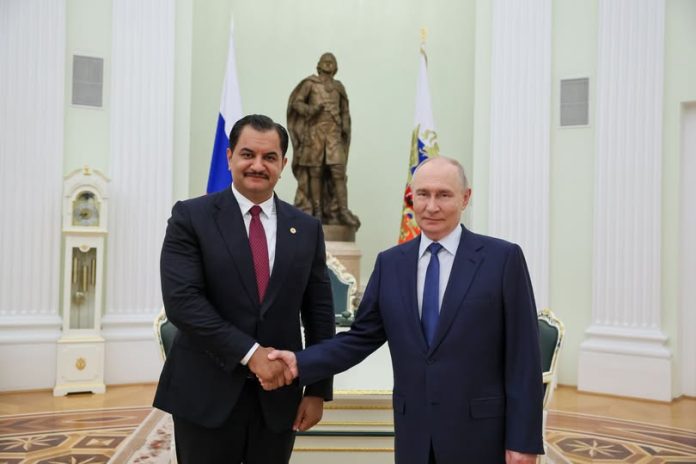
The meeting at the Kremlin highlights Moscow’s growing interest in consolidating its relationship with Libya and opens the door to closer cooperation on security, stability and institutional unification.
SoldeCanarias.net / Editorial Staff”.
Saddam Haftar, one of the emerging figures in Libya’s political and military landscape, met with Russian President Vladimir Putin in Moscow in talks that underscore Russia’s growing influence in the North African country.
The meeting, held at the Kremlin Palace, focused on the situation in Libya, regional security and prospects for bilateral cooperation. Haftar highlighted Russia’s role in supporting security and stability in Libya and reaffirmed his backing for efforts aimed at unifying the country’s institutions.
The meeting comes at a time of continued political and institutional fragmentation in Libya, as well as growing competition among international actors seeking to expand their influence in the country. For Moscow, Libya also represents a strategic foothold in the Mediterranean and North Africa, a region where Russia has sought to maintain and expand its presence.
During the talks, both sides stressed the importance of deepening cooperation between Libya and Russia across a range of sectors. Haftar presented the relationship as a potential path toward a strategic partnership, based on shared interests and aimed at strengthening regional security and stability.
Beyond the bilateral dimension, the meeting carries a significant political message. Direct engagement with Putin places Saddam Haftar within a broader framework of international diplomacy and reflects the importance that various foreign actors attach to the political and security structures linked to eastern Libya.
The rapprochement with Moscow should also be viewed against the backdrop of ongoing, but still incomplete, efforts to reunify Libya’s institutions and establish greater political stability. The consolidation of any future cooperation, however, will depend on the evolution of Libya’s domestic political process and the ability of its competing factions to reach lasting agreements.
The Kremlin meeting therefore confirms that Russia remains a significant player in the Libyan equation, while Saddam Haftar seeks to strengthen his profile as an international interlocutor capable of participating in discussions over the country’s future. The evolution of this relationship could have implications not only for Libya, but also for the wider strategic balance across the Mediterranean and North Africa.